How to choose a video production company in Sydney
To choose a video production company in Sydney, start with your goal, not their showreel. Shortlist three companies that have made work for businesses like yours. Ask each one how they would use the video after it's made, who will be on set, and what you'll own at the end. Then compare written quotes line by line. The right company asks more about your sales and your audience than about cameras. The wrong one sends a price before it understands the job.
That's the short version. The rest of this guide is the checklist we'd use if we were hiring a crew ourselves, after ten years of running shoots across Sydney and regional Australia. If you want to see how we run video production in Sydney for businesses that build things, that page covers our process. This one is about how to judge anyone, us included.
Step 1: Get clear on the job before you look
Most bad hires start with a vague brief. "We need a video" gets you a lot of very different quotes, and you can't compare them because each company has guessed a different job.
Before you search, write down three things.
- What should change after people watch it? More enquiries, more enrolments, a shorter sales cycle, a safer worksite. Pick one.
- Who is watching, and where? A procurement manager on LinkedIn, a farmer scrolling Instagram on a Sunday night, a new starter in an induction room.
- What happens to it after launch? One video on the homepage is a very different job from a library of short cuts for paid ads and social.
That last point matters more than people expect. A single hero video often gets a month of attention and then sits on the website. A shoot that's planned to produce many shorter pieces keeps working for a year. If your answer is "we want content we can keep using", look for a partner who plans the content and the distribution together, before anyone books a camera.
Step 2: Build a shortlist of three
Sydney has hundreds of production companies, from solo shooters in Marrickville to large studios in Surry Hills and Pyrmont. You don't need to talk to twenty. Three is enough to see the range.
Good places to find them:
- Your own industry. Find a video from a competitor or supplier that you admire, then find out who made it. Credits are often in the YouTube description or the LinkedIn post.
- Google reviews. Skip past the five star reviews and read the three star ones. They show how a company handles problems.
- Referrals. Ask your marketing contacts who they'd hire again. "Again" is the important word.
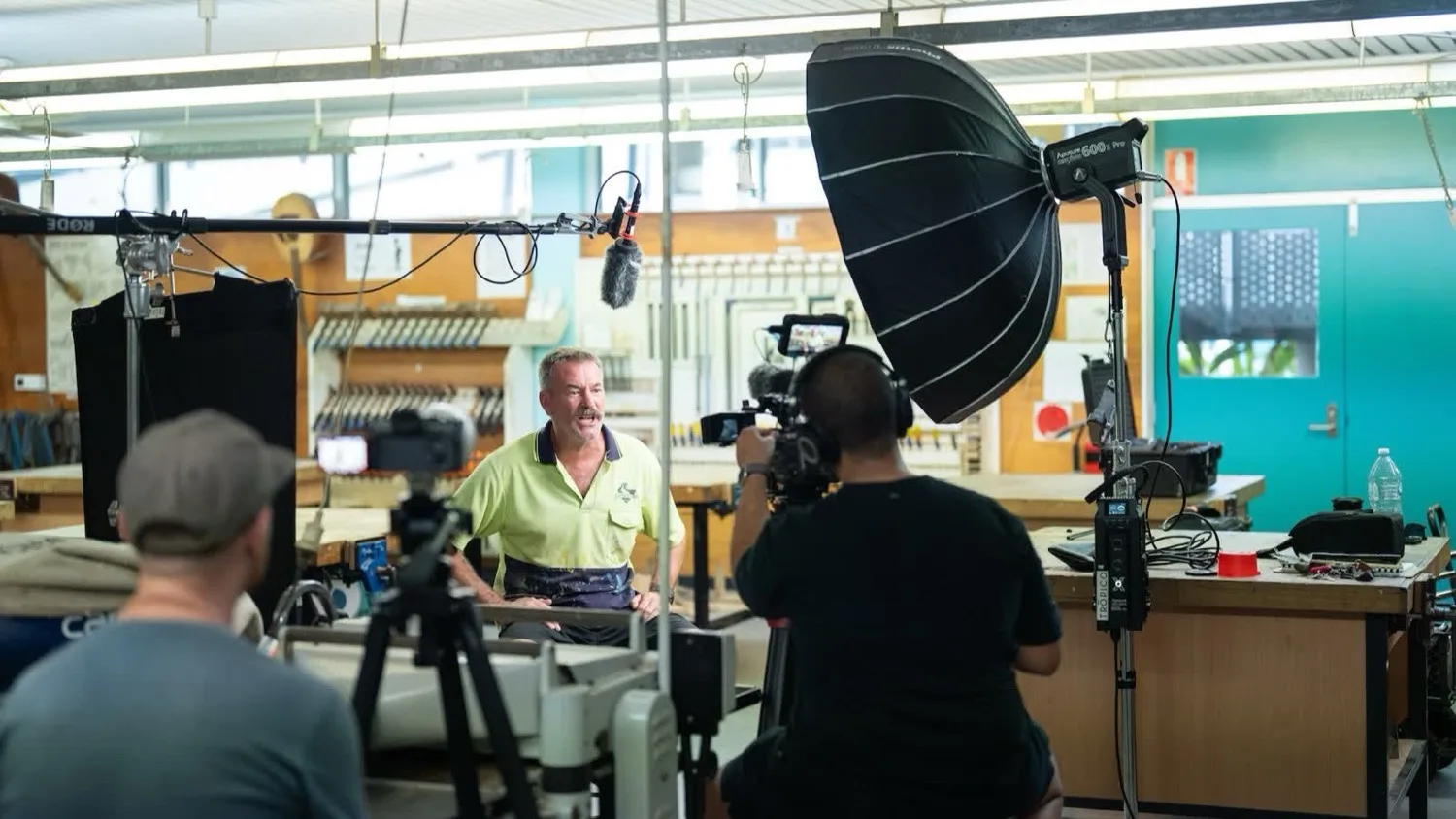
Then cut the list hard. If a company has never filmed in an environment like yours, that's a real risk. Filming in a factory with forklifts and hearing protection is a different skill from filming a cafe. Filming on a university campus means consent forms and student releases. A crew that already knows the rules of your world saves you weeks.
Step 3: Read the portfolio properly
A showreel is a highlight tape. It's cut to music, it's two minutes long, and it shows the best three seconds of forty jobs. It tells you a company can shoot nice images. It doesn't tell you whether they can make a video that works.
Ask to see three full videos instead, ideally from your sector. Watch them as your customer would, with the sound on. Then ask yourself:
- Do the first five seconds give you a reason to keep watching?
- Do the people on camera sound relaxed, or do they sound like they're reading a hostage statement?
- Is the message clear by the end, or is it just pretty footage?
- Is the audio clean? Bad sound is the fastest way to make a business look cheap.
Then ask the question most buyers forget: what happened after this video went out? A good company can tell you. A great one tracked it.
Step 4: Ask for results, not views
Views are easy to talk about and easy to buy. Any company running paid promotion can show you big numbers. What you want is evidence that the video moved something the client cared about.
Here's what that looks like in practice. For UNSW's Gateway Program, the goal wasn't reach. It was enrolments. The video campaign we produced was credited with a 4% increase in program enrolment, and the program hit its full enrolment target early. That's the kind of answer you're listening for: a business goal, a result tied to it, and a client who came back for more work.
If a company can only talk about views, likes and "engagement", ask them directly what the video was meant to do for the client's business. If they can't answer, they probably weren't asked, and they won't ask you either.
Step 5: What to ask on the first call
The first call tells you more than any portfolio. Listen to how much they ask versus how much they pitch. These are the questions we'd want answered.
About the work
- Who writes the script or the interview questions, and when do I see them?
- Who will actually be on set on the day? The person on this call, or a freelancer I haven't met?
- How many rounds of edits are included, and what counts as a round?
- What formats do I get? A 16:9 master for YouTube and your website, plus 9:16 vertical cuts for Instagram Reels, TikTok and LinkedIn, should be standard now.
About the business side
- Can you send your public liability insurance certificate? Most councils, universities and large worksites won't let a crew on site without one.
- Do your crew hold a current Working With Children Check if we're filming in schools or with under 18s?
- If we need drone footage, is your pilot licensed with CASA, and who handles airspace approvals near Sydney Airport or Bankstown?
- Is the music licensed for paid ads, or only for organic posts? Stock music licences vary, and an unlicensed track can get an ad pulled.
About what you own
- Who owns the final videos and the raw footage? Under the Copyright Act 1968, the person who shoots footage usually owns it unless the contract says otherwise, so get it in writing.
- Can we use the footage in future edits, or do we have to come back to you?
- How long do you keep the raw files after the job?
A company that answers all of these without hesitating has done this many times. One that says "we'll sort that out later" will make it your problem later.
Step 6: Compare quotes line by line
Quotes are where buyers get caught. Two quotes for "a two minute brand video" can describe completely different jobs. One might include strategy, scripting, a two person crew, a full day of filming and three rounds of edits. Another might be one shooter for half a day and a single edit. The cheaper quote isn't cheaper if you end up paying to fix it.
Put each quote into the same table so you're comparing like with like.
| What to check | What a clear quote shows | Red flag |
|---|---|---|
| Pre-production | Strategy, script or questions, shot list, location scout | "Concept development" with no detail |
| Crew | Named roles and how many people on set | "Videographer" with no number |
| Filming time | Hours or days, and how many locations | No time stated |
| Editing | Number of edit rounds, what counts as a round | "Unlimited revisions" |
| Deliverables | Every cut, length and aspect ratio listed | "One video" with no formats |
| Extras | Music, motion graphics, captions, drone, talent | All "available on request" |
| Rights | Who owns the footage and where it can run | Not mentioned |
A word on "unlimited revisions". It sounds generous. In practice it usually means nobody has agreed on what the video is meant to do, so the edit goes round and round. A clear brief and two or three agreed rounds produce a better video, faster.
If you want to know what a fair price looks like before the quotes arrive, we've broken it down in our guide to corporate video production cost in Australia.
Red flags to walk away from
Some warning signs are worth acting on straight away.
- A price before a conversation. If they quote from a contact form, they're selling a package, not solving your problem.
- Gear talk instead of goal talk. Cinema cameras are nice. They don't fix a weak message.
- No contract, or a one line invoice. You want a written scope that spells out every deliverable and who owns it.
- All the portfolio is from one kind of client. A crew that only shoots weddings or music clips will struggle in a manufacturing plant.
- They can't name who will be on set. Plenty of good companies use freelance crew. Good ones tell you who and brief them properly.
- Big promises about going viral. Nobody can promise that. People who do are guessing.
Production company, freelancer or growth partner?
Not every job needs the same kind of supplier. Here's a simple way to think about it.
- A freelance videographer suits a simple, one-off job: an event recap, a quick interview, extra footage for your in-house team. You'll do the planning and the brief yourself.
- A production company suits a bigger single project: a brand film, a capability video for a tender, a training series. They handle planning, crew and edit.
- A growth partner suits a business that wants video to bring in work month after month. The shoot is planned around a content calendar and paid ads, so one filming day turns into weeks of posts and campaigns.
If you're weighing up building your own team instead, our guide to in-house vs outsourced video production covers that choice.
Frequently asked questions
How many video production companies should I get quotes from?
Three is usually enough. It shows you the range of approaches and prices without eating weeks of your time. Make sure all three get the same written brief, or the quotes won't be comparable.
Should I choose a video production company based in Sydney?
If most of your filming is in Sydney, a local crew saves on travel and can do site visits before the shoot. For regional or interstate filming, it matters more that the company has worked in places like yours than where its office is.
What should a video production brief include?
The goal of the video, the audience, where it will be shown, key messages, any must-have shots or people, your deadline and your budget range. A short brief with a clear goal beats a long one without it.
Who owns the footage after a video shoot?
It depends on the contract. In Australia, the person or company that shoots the footage usually owns the copyright unless the agreement assigns it to you. Ask for ownership of the final videos and a licence or ownership of the raw footage, in writing, before you sign.
How long does a corporate video take to produce?
A simple project can go from brief to final edit in two to four weeks. Bigger jobs with several locations, approvals from legal or compliance, or many cuts can take six to eight weeks. Approvals on your side are often the slowest part.
What's the biggest mistake people make when hiring a video company?
Choosing on the showreel and the price alone. A beautiful video that nobody watches, or that doesn't say anything your customer cares about, is the most expensive kind. Choose the company that asks the best questions about your business.
The short answer, again
Know your goal. Shortlist three companies that have worked in your world. Watch full videos, not showreels. Ask what the work achieved. Get insurance, rights and edit rounds in writing, and compare quotes in one table. Pick the team that spends the first call asking about your customers.
If you'd like to see how we plan a shoot around a business goal, from the first call to the content calendar, start with our approach to video production in Sydney for established businesses.