
Planning an agricultural video shoot around the season
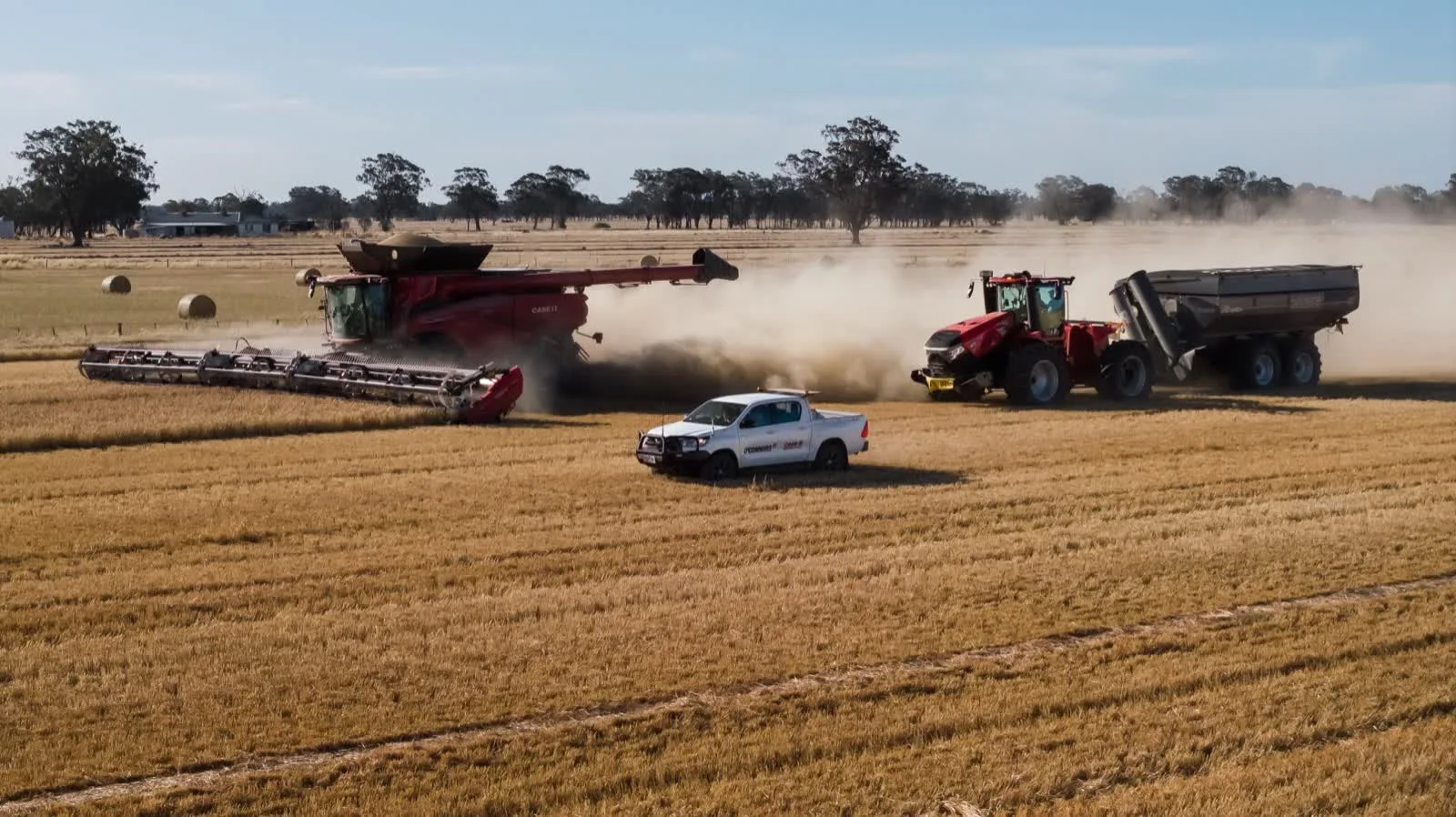
Plan an agricultural video shoot backwards from the paddock, not forwards from the marketing calendar. Start with the job you need on camera (harvest, seeding, spraying, tillage), find the window when that job actually happens in your buyers' region, then book the crew, the machines and the property around it. Leave room for weather, because the crop decides the date, not you.
That's the short answer. The rest of this piece is how it plays out on real farms, using shoots we've run for Case IH and New Holland from Dalby in Queensland to Swan Hill in Victoria.
If you're weighing up a partner for the whole thing, our agricultural video production page covers how we plan, film and run the campaigns. This article is about the planning, because that's where most farm shoots are won or lost.
Why the season has to lead the plan
Most marketing gets planned on a calendar. Launch in March, campaign in June, video by the end of the quarter.
Farms don't work like that. A header only runs when the crop is ready. An air seeder only runs when there's moisture in the ground. A Quadtrac pulling a Speedtiller through stubble only happens in the short gap between harvest and the next sowing.
Miss that window and you have two bad options. Wait up to a year for it to come round again, or fake it. Faking it means a machine idling in a bare paddock, or a combine driving through nothing. Your buyers will spot that in about two seconds. These are people who know exactly what a header looks like with a full bin and what it looks like for show.
So the first planning question is never "when do we want the video?" It's "when is the machine doing the job we want to show, and where?"
The grain calendar, in plain terms
Every region and every season is different, so treat this as a starting point and confirm dates with the grower or dealer on the ground.
- Winter crop sowing (wheat, barley, canola): roughly April to June across most of the grain belt. This is your window for air seeders, planters and big tractors in dark, worked soil.
- Spraying and crop growth: winter and early spring. Green paddocks, sprayers, agronomists walking crops.
- Winter crop harvest: starts in central and southern Queensland around September and October, then moves south through New South Wales into Victoria, South Australia and Western Australia through November and December, with some southern districts running into January.
- Summer crops (sorghum, cotton and others): planted from about October to January, harvested from about February to June, mostly in northern New South Wales and Queensland.
- After harvest: stubble management and tillage, typically summer into autumn, before the next sowing.
The key detail is that harvest moves. It travels south across the country over several months. That works in your favour if you plan for it.
What that looked like on our own shoots
Our CNH Industrial work makes the pattern easy to see, because the shoots line up with the season almost exactly.
- October 2025, Dalby, Queensland: a New Holland CR10 combine harvesting. Queensland harvest comes early, so this was the first harvest window of the year.
- December 2025, Swan Hill, Victoria: a Case IH Axial-Flow combine unloading on the go into a chaser bin, with dust hanging over a golden crop. Two months later and more than 1,000 kilometres south, the same job was ready to film again.
- January 2024: a Case IH Quadtrac pulling a Speedtiller through dry stubble. That's post-harvest work, and the dust it throws up is half the shot.
- May 2023 and May 2026: seeding. A Case IH air seeder rig and a Magnum with a planter working dark soil, then a New Holland T9 with an air seeder in a stubble paddock. Autumn is the only time those rigs are out in force.
None of those dates was picked for a campaign. They were picked because that's when the machine was doing its real job. The campaign then got built around the footage.
Five things to lock in before you book a crew
1. The job, the machine and the paddock
Name the exact model and the exact task. "A combine harvesting" isn't a brief. "An Axial-Flow harvesting wheat with a chaser bin alongside" is. Then find a property where that machine will be doing that job in that window. For equipment brands, the dealer network is usually the fastest way to find a grower who's happy to host.
Check the implement matches the horsepower and the crop matches the region. Farmers notice when it doesn't, and one wrong detail makes the whole piece read like an ad.
2. A window, not a date
You can't book harvest for a Tuesday. The crop has to dry down to a moisture level the buyer will accept before the headers go in. Rain can stop work for days. In fire season, many districts pull headers out of paddocks on high fire danger days.
So book a window. A flexible run of days, with the crew on standby and a clear call time the night before. Agree up front who makes the go or no-go call (usually the grower, because it's their crop) and when.
3. A wet weather plan that still makes content
A rained-out day doesn't have to be a lost day. Have a short list ready for when the paddock is off limits:
- Operator interviews in the shed or the cab.
- Machinery detail shots under cover: the cab, the controls, the screens, the header front.
- Walkarounds with the dealer or product specialist.
- Workshop and maintenance footage, which buyers often trust more than the hero shots.
If the weather turns, the crew moves to the B list and the hero footage moves to the next dry day in the window.
4. The property and the people
A working farm is a workplace in its busiest weeks. Plan for it.
- Access and induction. Who meets the crew at the gate, where they park, what they can and can't drive on.
- Biosecurity. Many properties have a farm biosecurity plan. Follow the "come clean, go clean" approach: clean boots and vehicles, and ask before moving between paddocks or properties.
- Safety around machinery. Agree how the crew talks to operators (UHF channel, hand signals) and where they stand. Nobody walks in front of a header to get a shot.
- Drones. Most of the best farm shots are aerial. Check the drone pilot holds the right CASA licence for commercial work and knows the rules about flying near people and machinery.
5. Travel and light
Regional shoots mean early starts and long drives. Build in the travel day, and book accommodation close to the property, because harvest towns fill up.
Light matters too. The low sun at either end of the day gives you the golden crop and the long shadows that make a header look the way buyers remember it. Midday light is flat and harsh. Plan the hero sequences for early or late, and use the middle of the day for interviews and details.
Get more from every window
Because the windows are short, each one has to work hard. A single harvest day can cover a lot of ground if it's planned for it:
- A hero film for the website and the dealer network.
- Vertical cuts for Instagram and Facebook, filmed for vertical, not cropped later.
- Short operator stories and testimonials.
- A library of stills for brochures, ads and the next product launch.
Plan the shot list for all of those before the crew arrives. Once the crop is off, you can't go back for the vertical version.
And leave some room for the unplanned. One of the best performing pieces from our CNH work, a Case IH reel built around a kid playing with a toy Quadtrac in a paddock, reached 751,000 views. It wasn't a machinery spec piece. It was a moment that felt like real farm life, and it was only possible because the crew was on a working farm, at the right time, with time to notice it.
Line the shoot up with the buying season
The filming window and the selling window aren't the same thing, and that's useful.
Growers often make big equipment decisions around harvest results, field days and the end of the financial year. If you film harvest in December, that footage can carry a campaign into the following autumn and winter, when buyers are planning for the next season.
So map both calendars together: when you can film each job, and when your buyers are deciding. Film one season, sell into the next.
Common mistakes
- Booking the date before checking the crop. The fix is a window and a go or no-go call.
- Using the wrong machine for the story. A demo model in the wrong region or on the wrong crop undoes the whole piece.
- Filming only the hero shots. No interviews, no details, no vertical. Then a second shoot is needed for the rest.
- Forgetting the grower. They're hosting you in their busiest weeks. Keep the footprint small and say thank you properly.
- Stock footage to fill the gaps. Farmers can tell. Film it or leave it out.
FAQ
When is the best time of year to film harvest in Australia?
It depends on the region. Winter crop harvest usually starts in Queensland around September and October and moves south through New South Wales, Victoria, South Australia and Western Australia through November and December. Confirm the timing with a local grower or dealer, and book a window rather than a fixed date.
How far ahead should we plan an agricultural video shoot?
Start when you know which job you want on camera, ideally a few months before that window opens. That gives time to find a property, line up the machine and operator, and agree a flexible booking with the crew.
What happens if it rains on the day?
Move to the wet weather list: interviews, machinery details under cover, walkarounds and workshop footage. The hero paddock footage moves to the next dry day in the booked window.
Can you film machinery outside its working season?
You can film walkarounds, details and interviews any time. But a machine shown doing a job it isn't really doing looks staged to an experienced buyer. For hero footage, film the real job in its real window.
Do we need permission to fly a drone over a farm?
You need the landholder's permission, and commercial drone work needs to follow CASA rules. Check your pilot is licensed for commercial work and plans flights around people, machinery and any nearby airstrips.
Who should be on site from our side?
Someone who can make decisions on the day, plus a product specialist or dealer contact who knows the machine. The grower or operator decides when the machine can run. Agree those roles before the crew arrives.
The short version
Let the crop set the date. Pick the job, find the window, book flexibly, plan for rain, and film everything you'll need while the machine is doing the real thing. Then sell the footage into the season your buyers are deciding in.
If you want help planning the next one, see how we approach video production for agricultural brands, or read the CNH Industrial case study. Let's map out the content your business actually needs.